Great edtalk by Mark Osborne, to begin thinking about learner orientation and what it means.
Learner Orientation
This would be great to show at a teacher meeting to begin the discussion around current pedagogy, curriculum and assessment. Are we meeting the needs of our learners?
Wednesday, September 24, 2014

Tuesday, September 2, 2014

Future Learning
We are into our next module called "Rethinking Teaching". This is the moment when we begin to challenge and confront our traditional beliefs around the role and purpose of the teacher - is our pedagogy and practice relevant to today's learner. We are preparing our learners for an unknown future - today's 5yr olds will be 25 in 2034! Can we afford to hold onto practices and thinking that is grounded in the past, when we are facing a technological revolution. Our students are born into a technological world - knowledge is at their fingertips. So, how does the role of the teacher change, so that we can best meet the needs of TODAY'S learners?
The clip below delves into the idea of "future learning" - what should it look like and why do we need to make the change. While there are many challenging statements made, a couple resonated with me, and provides food for thought.
Dr Sugata Mitra talks about how our past, and possibly current, education system, is intent on producing "photocopies" of one another.
He also talks about how he believes that a future-focused curriculum should be focused on 3 aspects:
1. Reading comprehension - the single most important thing
2. Information search and retrieval skills
3. Teaching our children to believe (To provide armour against doctrine)
Future Learning
Love this clip. I love the section where Dr Sugata Mitra put computers in the slums in India and without any help, and the children did not speak English, within 5 hurs they had collaboratively taught themselves how to use a computer.
I agreed when it talked about children losing motivation in schools and how using technology increases that. I love the section analysing what children do when they play video games. We need to capture that motivation. The clip talks about how computers should be used in classes to practice the maths and literacy skills and teachers can concentrate on the higher order thinking tasks. Children need to work collaboratively to help design their curriculum.
Love this clip. I love the section where Dr Sugata Mitra put computers in the slums in India and without any help, and the children did not speak English, within 5 hurs they had collaboratively taught themselves how to use a computer.
I agreed when it talked about children losing motivation in schools and how using technology increases that. I love the section analysing what children do when they play video games. We need to capture that motivation. The clip talks about how computers should be used in classes to practice the maths and literacy skills and teachers can concentrate on the higher order thinking tasks. Children need to work collaboratively to help design their curriculum.
Monday, September 1, 2014
Learner Charters
"Student voice" - what does it sound like? Are we really considering the depth of our students voice and choice in their own learning - the following graphic is a powerful set of questions that teachers can ask themselves. What would the answers be in your own class?

Another tool for embracing student voice, agency or choice is through the use of a "Learner Charter"
Thursday, August 21, 2014
Learners as Teachers
We both love this You tube clip.
Kid President's Pep Talk to Teachers and Students!
We have been thinking alot about our curriculum especially in terms of opening our MLE next year. We need to ensure that our Learners are Teachers and that we are future focussed and their learning is shared.
I was doing some research the other day from the Manaiakalani Cluster and in particular Pt England. Their curriculum is based on 3 principles. "Learn, Create, Share"
With this in mind we wanted to ensure that our Inquiry Model had an element of doing something with their learning, making a difference. So we re-developed the Inquiry Model for our School.
Tuakau Inquiry Model

We particularly value the stage "Keep and Discard' With the wealth of information available to the 21st Century Learners this stage is really important. In previous Action Learning models I have used with children. They often just find the first source and we really need to spend time looking at what is relevant information, and is their a better source and comparing and contrasting information.
Also the stage "Use your learning to make a difference" is important to our school. With our learners as teachers they have a responsibility to make a difference to the world we live in.
21st Century Learners
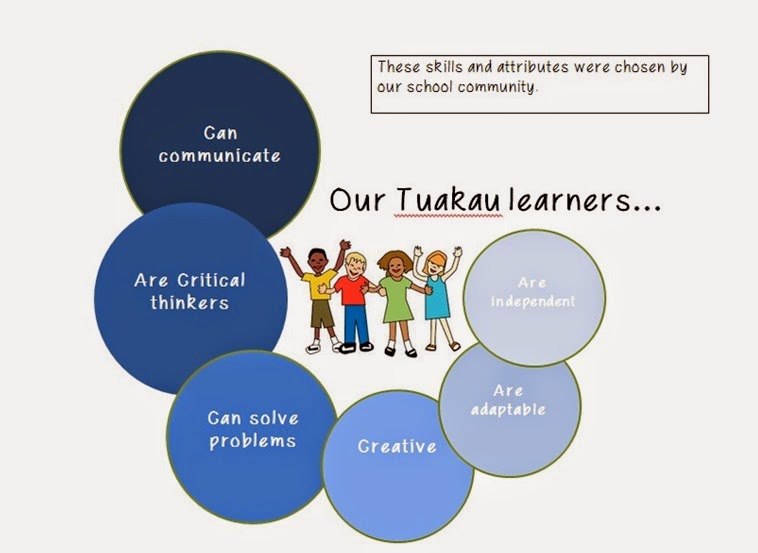
We have been doing lots of reading about the Skills and Dispositions of 21st century learners and we have been comparing these with the skills that our parents want for their students. We surveyed parents recently on what they want for their Year 6 pupils. (See below)

The
Skills and Attributes of Today's Learner. It includes some very important ones
like "collaboration across networks" We have been having big
discussions about this point. Its related to Derek Wenmoth's key driver of
change 'Connectedness" where learning happens across networks, social
media and personal learning communities. This graphic has skills like
"grit' and 'hope and optimism' and 'adaptability'
Very interesting skills and something to think about in terms of how to we ensure our curriculum gives opportunities for our learners to develop these skills.

Vanessa really liked this graphic
Very interesting skills and something to think about in terms of how to we ensure our curriculum gives opportunities for our learners to develop these skills.
One of the readings that interested me was ...
Especially the Digital skills. We need to
discuss with the leadership team and Whanau about these digital skills and
providing opportunities for students to use these skills in their learning.
Things like tweeting. We need to discuss as a leadership team about using
social media such as twitter in the classroom. Implications of this are about
cyber safety and I would like to work with students to create proposals to
present to the leadership team on how we could use Social media in the
classroom. I would like to survey a group of senior students to test their
abilities in those digital skills as my assumption is they will be able to do
most of them, and then use this group of students to help plan ways to use
these skills in their learning.
Tina
Tuesday, August 19, 2014
The 3 drivers of change..
Tina and I have been discussing the 3 drivers of change - what are they and what do they mean?
Student Agency - The ability to make a choice and act on those choices to make a difference in their lives. What does this mean for learners? Learners are active in the learning process, contributing to learning, creating learning and collaborating in learning.
Connectedness - (Connected Minds) Being connected and engaged with information. Promoting collaboration through the use of technology. Through the use of networked technology, learning can happen outside the learner, within personal learning communities and social networks. Ready and instantaneous access to expert information.
Ubiquity - Learning is no longer bound to a particular place in time - learning can happen anywhere, any time and does not stop at the school gate.
Student Agency - The ability to make a choice and act on those choices to make a difference in their lives. What does this mean for learners? Learners are active in the learning process, contributing to learning, creating learning and collaborating in learning.
Connectedness - (Connected Minds) Being connected and engaged with information. Promoting collaboration through the use of technology. Through the use of networked technology, learning can happen outside the learner, within personal learning communities and social networks. Ready and instantaneous access to expert information.
Ubiquity - Learning is no longer bound to a particular place in time - learning can happen anywhere, any time and does not stop at the school gate.
Subscribe to:
Posts (Atom)